
DIVORCE LAWYER
 Divorce is the termination of the marriage union. The divorce case is when one of the spouses presents the disputes that cause divorce and the request for divorce to the court with a divorce petition for the termination of the existing marriage. There is misinformation about the divorce case that many people have an idea about. With this article, which we have prepared in order to be the right guide for those who are in the divorce process, we will answer the most curious questions about the divorce case.Contact for details
1-What are the reasons for divorce?
In order to file a divorce case, it is necessary to show at least one of the reasons for divorce written in the Turkish Civil Code as a reason for divorce. The reasons for divorce are divided into two as special and general. The general reason for divorce is the shaking of the marriage union from its foundations, popularly known as severe incompatibility. The general ground for divorce is regulated in Article 166 of the law. The spouse who wants to divorce by claiming the general ground for divorce must prove that the other spouse is at fault. Special grounds for divorce are regulated separately in Articles 161-165 of the law. The spouse who wants to divorce by claiming special grounds for divorce must prove the existence of this ground. The special grounds for divorce written in the law are as follows:
- Divorce on the grounds of adultery (Article 161 of the Civil Code),
- Divorce on the grounds of Castration for Life, Grossly Bad or Degrading Behaviour (Article 162 of the Civil Code),
- Divorce case on the grounds of committing a crime and leading a dishonourable life (Article 163 of the Civil Code),
- Divorce on the grounds of abandonment (Article 164 of the Civil Code),
- Divorce case due to mental illness (Article 165 of the Civil Code).
2-What are the types of divorce cases?
In the Turkish Legal System, there are two types of divorce cases: uncontested divorce case and contentious divorce case.
2.1-What is an uncontested divorce?
The uncontested divorce case is regulated in paragraph 3 of Article 166 of the Turkish Civil Code. An uncontested divorce case is a type of divorce case filed on the grounds of the general reason for divorce. In other words, the marriage union is fundamentally shaken. In an uncontested divorce case, the spouses agree on the issues related to separation. Even if the spouses have agreed among themselves, the judge listens to the parties and may make the changes he/she deems appropriate in the agreement. Even if the spouses have agreed among themselves, divorce can only be realised if the judge approves.
2.1.a-What are the conditions for uncontested divorce?
There are some conditions for an uncontested divorce case, the necessary conditions are as follows
- The marriage union must have lasted for at least one year.
- Spouses must agree on divorce and its consequences.
- The spouses must repeat that they accept the divorce articles and consent in the presence of the judge.
- The judge must approve this agreement made between the spouses, divorce cannot be realised without the approval of the judge.
2.1.b-How long does an uncontested divorce case last?
Uncontested divorce cases take between 2-3 months on average. With a good divorce lawyer, this can be reduced even more.
2.2-What is contentious divorce?
If the spouses cannot agree on the issues related to divorce, a contentious divorce case is in question. While two parties apply for an uncontested divorce, only one party applies for a contentious divorce. The contentious divorce case can be filed based on both special grounds for divorce and general grounds for divorce. The judge evaluates the requests and claims of the parties within the framework of the evidence to support them and reaches a decision.
2.2.a-How long does a contested divorce case last?
Since there is no agreement between the spouses in contentious divorce cases, it takes longer than a contested divorce case. Contested divorce cases usually last between 8 months and 18 months. On average, we can talk about 1.5 years.
3-Where and how is the divorce case filed?
The court in charge of divorce cases is the family court. The competent court in the divorce case is the family court in the region where the spouses or one of the spouses resided in the last 6 months before the lawsuit was filed. The parties can file a divorce case by applying to the competent family court with a written petition.
4-How long does the divorce case last?
The duration of the divorce case varies according to the type of case. Uncontested divorce cases are concluded earlier compared to contentious divorce cases. Uncontested divorce cases usually take between 3-4 months. In contentious divorce cases, it is quite difficult to talk about a period of time.
difficult. Depending on the difficulty of the case, there are contentious divorce cases that take a very long time. You can reduce the duration of your divorce case by hiring a good divorce lawyer.
5-What are the rights of women in a divorce case?
Women can claim the following rights in a divorce case:
- -Right to Precautionary Alimony for the woman
- Right to maintenance for the child
- Right to maintenance
- Right to poverty alimony
- Woman’s right to financial compensation
- Woman’s right to moral compensation
- Right to live separately
- Right to request a family residence annotation
- Right to allocation of shared housing
- Right to request protection
- Claims due to division of property
- Right to claim personal belongings
- Right of custody of the child
- The right to personal contact with the child
- Women’s rights to jewellery
- Right to a free lawyer
6-What are the rights of the man in a divorce case?
- Right to live separately
- Right to allocation of the Common House
- Right of custody of the child
- The right to personal contact with the child
- Right to maintenance for the child
- Right to maintenance
- Right to poverty alimony
- Man’s right to financial compensation
- Man’s right to moral compensation
- Receivable right arising from property regime
- Right to request a family residence annotation
- Right to request protection
- Right to a free lawyer
- A man’s right to claim his own belongings
7-Evidence and proof in divorce case
The person who files for divorce is obliged to prove the allegations and the reasons for divorce. If the plaintiff cannot prove the reasons put forward, the lawsuit is rejected. The plaintiff has the right to use evidence in order to prove the reasons and claims for divorce, and the defendant has the right to use evidence to refute the plaintiff’s claims. The important point here is the use of evidence in accordance with the law. Unlawful evidence is not accepted. The prosecutor’s office may also open an investigation for showing illegal evidence.
7.1-What are the evidence in accordance with the law?
- SMS
- Social media posts
- Photos
- Hotel Registrations
- Camera footage
- Whatsapp conversations
- Notes, correspondence
- Witness
- Expert examination
- Court notice
- Economic and social situation survey
- Law enforcement investigation
- Bank or credit records
- Other court files
- Passport entry and exit records
8-Problems arising from divorce
With the realisation of divorce, many problems arise. The regulation of these problems is made by agreement between the spouses or by the judge. The legal problems arising from the dissolution of marriage are as follows:
8.1-Custody
Custody is the name given to the whole of the obligations that exist for the protection, care and representation of the child. The custodian has both responsibility and authority. When the mother and father are married, custody is common. However, with the realisation of divorce, a custody problem arises. In some cases, joint custody is in question after divorce, but generally custody is given to one party. The judge has a wide authority on custody. If there is an agreement between the parties about custody, the judge may make a different decision from this agreement. The judge may not give custody to both parties and may appoint a guardian for the child.
8.1.a-What is considered when determining custody?
In our legal system, the most important criterion evaluated when granting custody is the best interests of the child. The judge must primarily consider the best interests of the child when making the decision. If the child in question is old enough to comprehend the events, the judge takes the child’s request and opinion into consideration. The important thing is that the child will be raised better if he/she stays on which side. For this reason, when determining custody, situations such as the child’s age, gender, and who the child is studying with are evaluated.
The situation of the mother and father is also taken into consideration when determining custody. Whether the party requesting custody is interested in the child, the opportunities he/she can provide to the child, his/her health condition, the possibility of leaving the child to someone else, the possibility of neglecting and kidnapping the child, violence, unfaithfulness, economic situation, profession, living environment, alcohol addiction, unstable behaviours are also very important issues.
8.1.b- Custody of siblings to different spouses
If there is more than one child, it is not obligatory to give all children to the same spouse. Children can be given to different spouses.
8.1.c-Giving custody of the child to the mother
The age of the child is an important issue in determining custody. Since young children are in need of maternal care, custody is usually given to the mother.
8.1.d-Does the non-custodial spouse have rights over the child?
The personal relationship of the mother or father with the child is regulated even if he/she is not granted custody. The judge, again considering the best interests of the child, ensures that the child spends time with the non-custodial party at certain times.
8.1.e-Who is given custody of the child in divorce?
While deciding on custody in divorce, it is not very important whether they are at fault in the divorce or not, and their faults against the other spouse. Infidelity is a fault of one spouse against the other spouse; it is not related to the best interests of the child. Therefore, when the judge is evaluating to whom to award custody, the fact that one party has deceived the other does not affect this evaluation. In other words, the reason for divorce is not very effective in determining the custody of the child.
8.2 – Alimony
During the divorce proceedings and at the conclusion of the divorce proceedings, 3 types of alimony may be awarded:
8.2.a-Interim alimony
The type of alimony requested by one of the spouses from the other during the divorce case is called precautionary alimony. Precautionary alimony can be requested for the spouse himself/herself or for the minor child. Precautionary alimony is related to the accommodation, livelihood and care of the children of the economically difficult spouse. Since it is a temporary measure, it is decided to lift the alimony upon the termination of the lawsuit.
8.2.b- Subsidiary alimony
The contribution made by the non-custodial spouse in proportion to his/her economic power in order to be a partner in the care and education expenses of his/her child is called participation alimony. Contribution alimony is given to the spouse who has custody. This alimony continues until the child’s education life ends. After the age of 25, even if the child’s education life continues, the alimony of participation ends.
8.2.c-Poverty alimony
The spouse who will fall into poverty due to divorce may request alimony from the other spouse indefinitely in proportion to his/her financial capacity. Poverty alimony is regulated in the law as follows:
Article 175- ‘The party who will fall into poverty due to divorce may indefinitely request alimony from the other party in proportion to his/her financial capacity for his/her subsistence, provided that his/her fault is not more severe. The fault of the alimony obligor is not sought.
8.3-Compensation
The concept of compensation means compensating a damage that has occurred. Since it is foreseen in our law that the spouses may incur damages due to this decision in case of a divorce decision, it is accepted that this damage should be compensated by the faulty spouse. There are two types of compensation cases:
8.3.a-Material compensation in divorce
Some economic interests of the spouses may be damaged with the dissolution of the marriage union. At this point, the spouse who is less at fault or faultless in the divorce may claim compensation from the other spouse for the existing or expected interests damaged by the divorce.
8.3.b-Moral compensation in divorce
The dissolution of the marriage union through divorce may cause damage to personal rights and psychological breakdown due to the grief and sorrow of the person. In this case, the party whose personal rights have been damaged may claim moral compensation from the other party, who is at fault, in an amount appropriate to his/her ability to pay.
9-Stages of divorce process
The stages of the contentious divorce proceedings are regulated in the Code of Civil Procedure. Accordingly, the stages in divorce cases are as follows:
9.1-Petitions Stage
At the petitions stage, the parties shall submit the petition, the reply petition, the reply to the reply petition and the second reply petition.
9.2- Preliminary Examination Hearing Phase,
Preliminary Examination hearing is the stage where the dispute is determined and the parties are invited to settle.
9.3-Investigation Phase
The investigation stage is the stage where witnesses are heard, evidence is collected, expert examination and pedagogue examination are carried out, in other words, the parties try to prove their claims and defences in order to enlighten the file.
9.4 – Oral Trial Phase
The oral trial stage is the stage where the parties make statements about the entire file.
9.5 – Judgement Phase
It is the stage where the court announces the decision regarding the divorce case. The court will announce its decision on the case at the last hearing.
10-Cancellation and waiver of the divorce case
It is possible to waive or renounce the divorce cases filed. However, these transactions can be made before the final conclusion of the case.
10.1-Waiving the divorce case
When the divorce case is abandoned, i.e. when the divorce case is withdrawn, the case is deemed to have never been filed. Withdrawal of the divorce case can be realised with the explicit consent of the plaintiff party and the acceptance of the defendant party. The party who renounces the divorce case may file a divorce case again for the same or different reasons in the future.
10.2-Waiving the divorce case
The plaintiff spouse who wants to waive the divorce case can waive a certain part or all of the case by individual decision. The waiver decision can only be taken by the plaintiff spouse. When the divorce case is waived, a divorce case cannot be filed again for the same reason due to the waived divorce.
11-Is a lawyer important in a divorce case?
Couples who marry with great expectations but are unhappy when things do not go well and therefore resort to divorce option are quite high today. Divorce can have many material and moral negative consequences. Since many people in the divorce stage do not know their rights or do not work with a good lawyer, their cases may take much longer than they expect and they may face negative consequences when the case is finalised. For these reasons, choosing a good lawyer can both shorten the duration of your case and turn the outcome of the case in your favour. It will be a great opportunity for you to benefit from the successful and experienced divorce lawyers of Aşıkoğlu Law. You can turn your case result in your favour by working with our experienced lawyers.
12-How much are the divorce lawyer fees?
The divorce lawyer fee is at least 9.200 TL + VAT for 2023. Lawyer fees below this are prohibited. You can contact us to get fee information about Aşıkoğlu Law’s experienced and professional lawyers.
13-How much are the court costs in a divorce case?
The cost of filing a divorce case consists of certain fees. The application fee, advance fee, advance on expenses is 1.135,70 TL in total.
14-Divorce statistics
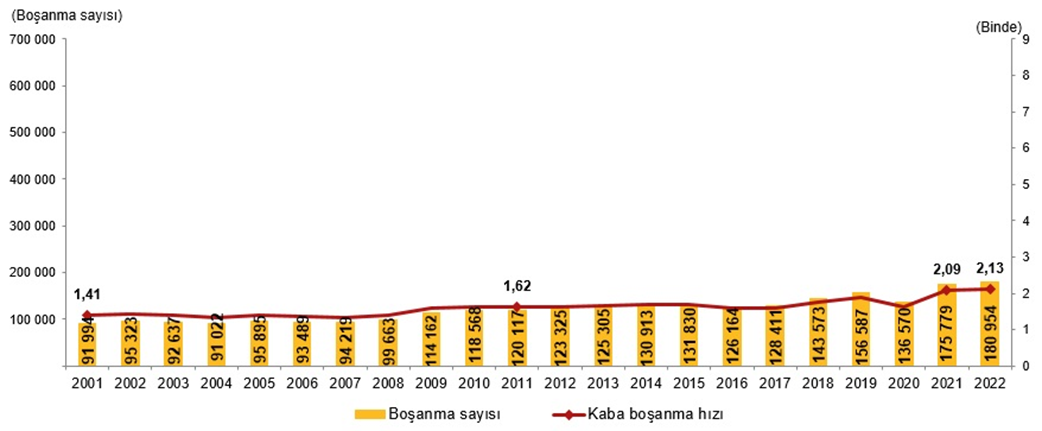
The number of divorced couples was 175 thousand 779 in 2021 and 180 thousand 954 in 2022. The crude divorce rate, which expresses the number of divorces per thousand population, was 2.13 per thousand in 2022.
Number of divorces and crude divorce rate, 2001-2022
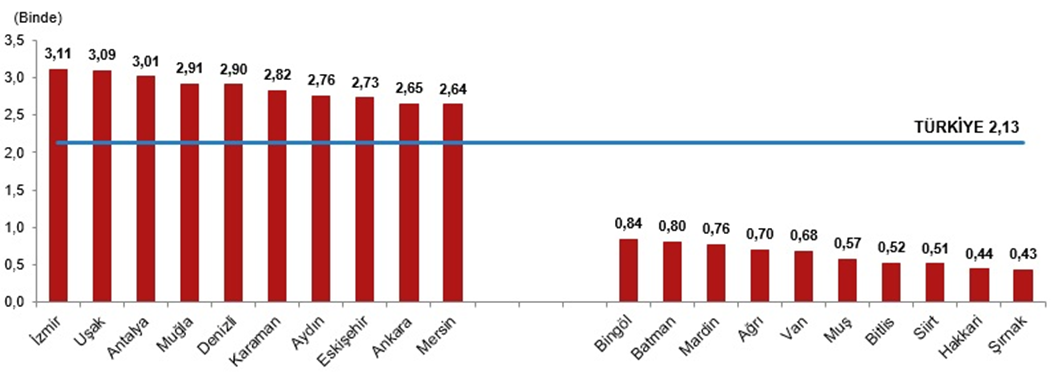
The province with the highest crude divorce rate was İzmir with 3.11 per thousand. The province with the highest crude divorce rate in 2022 was İzmir with 3.11 per thousand. This province was followed by Uşak with 3.09 per thousand and Antalya with 3.01 per thousand. The province with the lowest crude divorce rate was Şırnak with 0.43 per thousand. This province was followed by Hakkari with 0.44 per thousand and Siirt with 0.51 per thousand.
The 10 provinces with the highest and lowest crude divorce rate, 2022
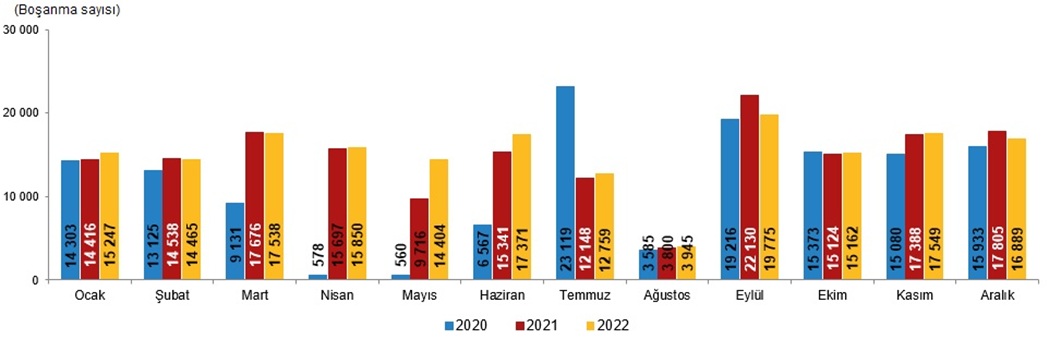
Significant differences were observed in the number of divorces by months. When the number of divorces was analysed by months, a significant decrease was observed in August due to the judicial holiday. While the number of divorces was 3 thousand 945 in August 2022, it increased 5.0 times and became 19 thousand 775 in September after the judicial holiday.
Number of divorces by months, 2020-2022
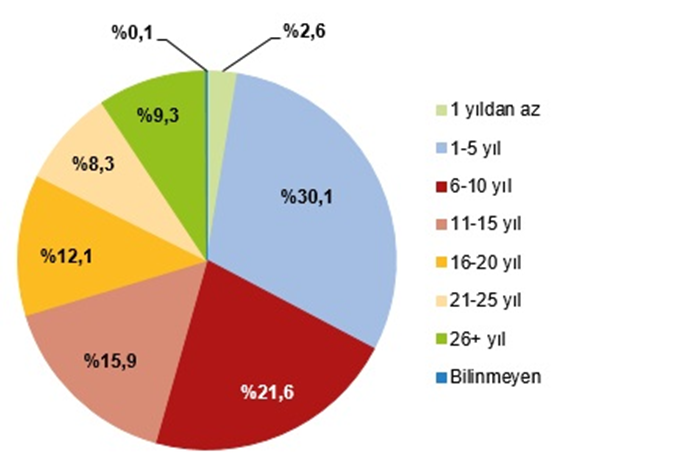
32.7% of divorces took place within the first five years of marriage. When divorces by duration of marriage are analysed, 32.7% of the divorces in 2022 took place within the first 5 years of marriage and 21.6% within 6-10 years of marriage.
Rate of divorces by duration of marriage, 2022
In the last year, 180 thousand 592 children were affected by divorce cases. As a result of finalised divorce cases, 180 thousand 954 couples divorced in 2022 and 180 thousand 592 children were given custody. As a result of divorce cases, it was observed that the custody of children was mostly given to the mother. In 2022, 75.7% of the custody of children was given to the mother and 24.3% to the father.
15-Other frequently asked questions about divorce
15.1 Can a divorce case be filed via e-government?
It is no longer necessary to go to court for the filing of cases by the Ministry of Justice. Divorce cases can be conducted within the scope of the National Judicial Network Project. The lawsuit petitions that can be prepared on the system through the editor can be opened without the need to go to the courthouse after signing the e-signature and making the fee payments.
15.2 – Is it more advantageous to file the divorce case first?
It does not matter who files the divorce case first. What is important in divorce cases is not who filed the case, but which of the parties is at fault or the degree of fault.
15.3- Who gets the jewellery worn at the wedding after the divorce?
In many precedent decisions, it has been decided that the gold jewellery worn at the wedding belongs to the woman. Since the gold jewellery worn at the wedding is personal property, it remains with the woman.
15.4-How long after the divorce can women get married?
In the Turkish legal system, a woman has to wait 300 days after the divorce is finalised. This period is to determine whether the woman is pregnant or not and to determine who the father of the child is. This period is called iddat period.
16-Sample of divorce petition
Example of an uncontested divorce petition:
……. TO THE COURT
CLAIMANT :…….
DEFENDANT :…….
DEFENDANT :…….
SUBJECT : Our Request for Collection of ……..
EXPLANATIONS : My client and the defendant ……. located at the address ……. Province, ……. District, ……. Neighbourhood, ……. ……., ……., ……., ……. parcel, ……., located at ……. address and registered to the title deed.
Pursuant to the contract dated …/../…., the defendant has not paid ………..-TL, which is required to be paid in order for the construction to start, until today, and the notice of …… Notary Public dated …/../…. and numbered …… has not yielded any results.
This behaviour of the defendant has left my client and other condominium owners in a difficult situation. As a result of the defendant’s failure to fulfil its obligations, the construction cannot be started and the construction costs are increasing day by day and causing losses to my client.
It has become necessary to file this lawsuit for the collection of …………-TL from the defendant who violated the contract.
- CAUSES : Condominium Law and Related Legislation
EVIDENCE : Land registry, Contract, Notice
CONCLUSION OF THE REQUEST : For the reasons stated above, we respectfully request and demand that the defendant be ordered to collect ………-TL, which the defendant is obliged to pay, from the defendant with legal interest from the date of …/…/…., to charge the defendant with the costs of the proceedings, and to award the counterparty attorney fee on our behalf as an attorney in accordance with the 164/last paragraph of the Attorneyship Law No. 1136 amended by Law No. 4667. …….
ATTORNEY FOR THE PLAINTIFF